

Lake Garda has never been an “easy” place.
It’s one of those environments that immediately puts you face to face with what you are in that exact moment: whether you’re ready, whether you’re forcing it, whether you’re managing, or whether you’re simply trying to survive.
It’s not just about the views, even if they are constantly in front of you.
It’s about rhythm, elevation that comes without warning, wind that changes direction when you least expect it, and roads that never really give you anything for free.
And that’s exactly why, every year, it becomes the real starting point of the season.
Arriving at the lake without having really ridden yet is a mistake many people make.
They show up at the Bike Festival with their mindset still stuck in winter, with a body that hasn’t found its balance yet, and with that “first ride feeling” that lasts far too long.
The problem is not the effort.
It’s not being ready to manage it.
But there are also those who show up at the Bike Festival with solid mileage already in their legs, those who spent the winter on the trainer, and those who, since March, despite the cold of the first rides, have kept the legs moving.
At the Bike Festival, we expect both:
those arriving a bit late into the cycling season and those already on the right path toward their best summer condition.
But if, before the Bike Festival, you feel like putting in some real effort and stepping into a true no room for tourists mindset, we’ve selected a few rides, both road and mountain bike, that won’t give you anything for free, but will give you exactly what you need.
There’s no need to look for the perfect route, and no need to chase numbers or performance right away.
What matters is getting back into the dynamics of riding: managing effort, climbing, descending, wind, and constant variation.
Lake Garda, in this sense, is a benchmark.
Save these rides.

MOUNTAIN BIKE — Strada del Ponale — Easy ride
It starts from Riva del Garda and in the first few meters it immediately feels accessible. The surface is smooth, the gradient manageable, and the open view over the lake distracts you just enough to forget what you’re actually doing.
That’s exactly where you go wrong.
The Ponale never puts you in real, obvious difficulty, but it slowly takes you out of balance. The climb is steady, never extreme, but long enough to force you to manage your pace from the very beginning. If you start too hard, you pay for it without even realizing it. If you stay too conservative, you simply lose time and rhythm.
It’s a route carved into the rock, with tunnels dug into the mountain and exposed sections that force you to stay focused, because you can’t just switch off. Even when it feels easy, it never really is.
The surface alternates between asphalt and compact gravel, but that’s not the point. The point is that there are no dead moments: you always have to work, always adapt, always stay inside the effort.
Length: ~20 km (round trip)
Elevation: ~600 m
Terrain: mixed asphalt / compact gravel
It’s not the hardest ride around Garda.
It’s the one that quietly tells you whether you’re ready or not.

MOUNTAIN BIKE — Malga Grassi Trail Tour — Medium ride
There are rides where you manage effort.
And then there are rides where you have to manage everything else.
The Malga Grassi Trail Tour, above Riva del Garda, is not a route you can easily read. It’s long, broken, irregular, and forces you out of the linear logic of pedaling.
The climb is never “clean”: it alternates between rideable sections and more technical parts where you have to find your own way forward. You can’t set a pace and hold it, you have to constantly adapt, change position, adjust intensity, and rethink your approach.
But it’s on the descent where everything truly changes.
Here, the bike stops being just about pushing and becomes about control. The trail is technical, rocky, sometimes narrow, with direction changes that don’t always allow you to anticipate what’s coming next. If you arrive tired and without clarity, you feel it immediately.
This is not a ride that forgives mistakes.
Length: ~25 km
Elevation: ~1100 m
Terrain: technical MTB / alpine trail
It’s one of those rides where the difference is not how hard you push, but how well you adapt to what you find.

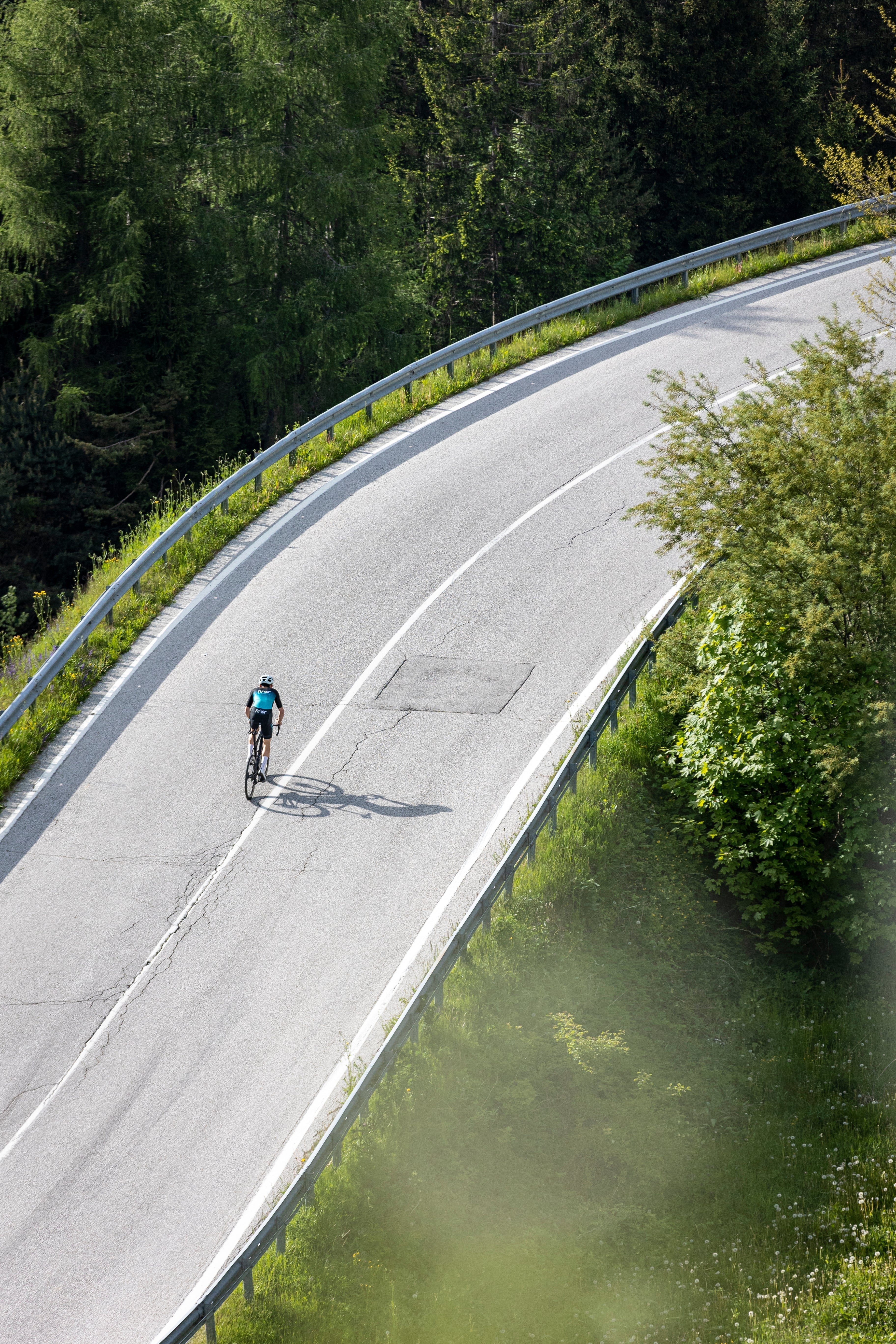
ROADBIKE — Garda–Sarca Loop — Medium ride
Not every ride challenges you through pure difficulty. Some do it through rhythm.
The Garda–Sarca loop, between Riva del Garda, Arco and the Sarca valley, is one of those.
It’s not a continuous climb, not a technical descent, and not even a route you can read linearly. It’s a sequence of variations: fast sections, direction changes, false flats, wind.
At first it feels smooth, almost too easy, like you can just let yourself go.
Then you start to realize that you never truly settle into a stable rhythm.
The pace keeps shifting, and if you’re not used to managing these transitions, you drain yourself without noticing. It’s not the peak effort that breaks you, but the accumulation of constant small adjustments.
Here, it’s all about knowing how to dose your effort.
Length: ~60–65 km
Elevation: ~900 m
Terrain: asphalt
It’s the kind of ride that teaches you how to stay inside the effort without overreaching, how to read what’s happening around you, and understand when to push and when to manage.

ROADBIKE — Lake Garda Loop — Difficult ride
Some routes challenge you from the very first kilometers, while others do it in a much more subtle way, without ever openly declaring it.
The full loop of Lake Garda belongs exactly to this second category, because on paper it never looks extreme: there are no impossible climbs, no gradients that force you to stop, and no moments where the effort explodes all at once.
And that’s exactly why it becomes a real test.
Starting from Riva del Garda, the first kilometers go by quickly, carried by a sense of ease that often leads you to underestimate what’s coming. The rhythm feels natural, the body responds well, and everything suggests it will be a manageable long ride.
Then the small changes begin, the ones that don’t make noise but build up over time: crosswinds forcing you to constantly adjust your position, tunnels breaking your rhythm and demanding attention, changes in traffic and road surface that never allow you to fully relax.
It’s never a single factor that makes it hard, but the accumulation of everything, kilometer after kilometer.
This is not a ride that asks for maximum effort, but for continuity, and continuity, over hours, becomes the real limit. You don’t get real breaks, you don’t get clear pauses, you only get the chance to manage what’s happening without losing balance.
Halfway through, you can no longer pretend it’s easy, because every decision made earlier starts to show: if you got nutrition wrong, you feel it; if you misjudged the pace, you pay for it; if you underestimated the conditions, it becomes obvious.
That’s where the ride really changes.
You’re no longer just riding around a lake, you’re inside a long, continuous management process, where the difference is not how hard you push, but how well you stay composed while everything accumulates.
Length: ~140–160 km
Elevation: ~400–500 m
Terrain: asphalt
It’s not the hardest ride around Garda, but it’s probably one of the most honest, because it doesn’t allow you to hide behind a single effort, and forces you to face your ability to manage over time.

Have we convinced you? Are you one of us?
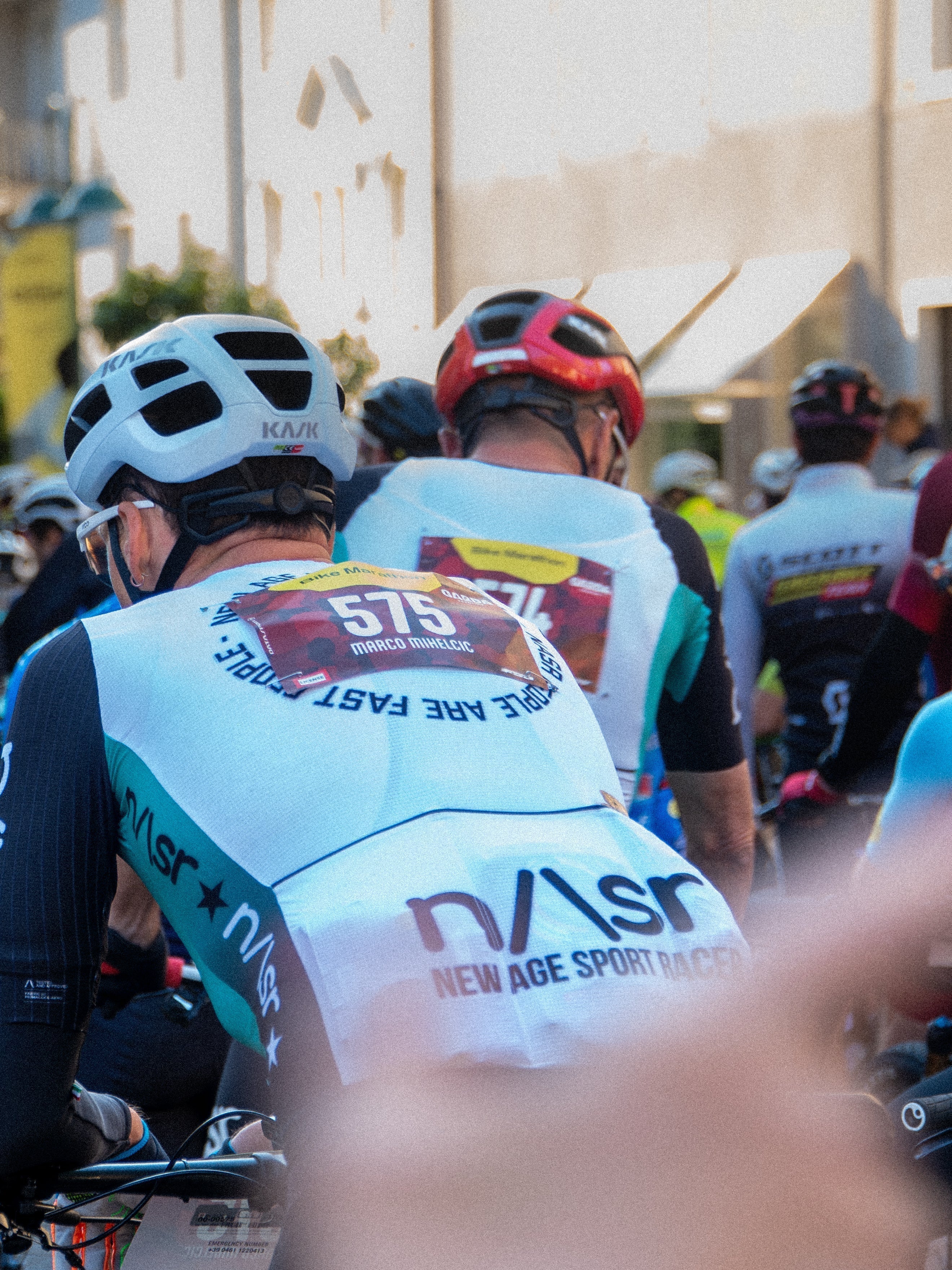
If you want to come and see where you really stand, we’ll be there from Friday, May 1st at the Bike Festival Riva del Garda.
Stop by to discover the new collection, to get hands-on with everything we’ve built for this cycling season, or simply to take a break and talk with others who, just like you, never really stopped.

Leave a comment
All comments are moderated before being published.
This site is protected by hCaptcha and the hCaptcha Privacy Policy and Terms of Service apply.